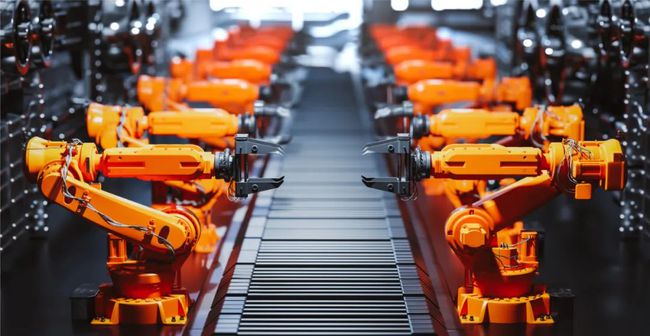
A factory of the future is a modern‑day facility spearheading advanced‑manufacturing development. It widely adopts new‑generation information technologies such as digital twins, artificial intelligence and big data to transform production modes. Driven by data, it reinvents production workflows. Built upon digital design, intelligent manufacturing and digital management, it features network‑enabled collaboration, personalized customization and service‑oriented extension. Targeting improved enterprise value chains and core competitiveness, it takes digital workshops and smart factories as its main carriers.
Intelligent manufacturing is not merely about deploying smart equipment to boost production efficiency and product quality. Instead, it leverages diverse machinery and equipment to optimize production processes and lift overall enterprise productivity. Specifically, intelligent manufacturing has three core characteristics:
◆ Intelligent‑enabled Equipment
Traditional enterprise IT infrastructure follows a five‑tier architecture: field‑level machines; PLC (Programmable Logic Controller) / DCS (Distributed Control System); SCADA (Supervisory Control And Data Acquisition) system; MES (Manufacturing Execution System); and ERP (Enterprise Resource Planning) / MRP (Manufacturing Resource Planning). Primarily designed to address industrial automation requirements, this architecture cannot perform real‑time analysis or generate real‑time feedback on equipment operating conditions.
The industrial‑internet platform adopts a four‑layer architecture: Edge Layer, IaaS Layer, PaaS Layer and SaaS Layer. Machines and equipment can invoke industrial mechanism models to conduct real‑time analysis of equipment status, driving the evolution of traditional industrial IoT technologies from edge‑control toward edge‑computing.
◆ Production Flexibility
Conventional automated production follows the principle of “dedicated lines for dedicated products”, suited for mass‑production of a limited product portfolio. When facing multi‑variant, small‑batch orders, traditional automated production lines suffer from long and unstable production cycles.
The Industrial Internet enables comprehensive perception and dynamic interaction. Sensors deployed on production lines automatically identify work‑in‑process components and transmit data across industrial‑internet nodes. Industrial mechanism models determine production routes and sequences for individual products. Combined with scheduling strategies, mixed‑model production becomes feasible, enhancing overall line agility to meet multi‑variant, small‑batch manufacturing demands.
◆ Dynamic Optimization
Under traditional production paradigms, industrial optimization means enterprises analyze operational performance from the previous production cycle, generate optimization schemes, and guide adjustments for subsequent cycles.
Optimization cycles for discrete industries are typically measured in days or weeks; for process industries, cycles are batch‑oriented. Industrial‑internet platforms interconnect production elements including manpower, machinery, materials, methods and environment to unify end‑to‑end data streams. Production status can be reflected in real‑time. By invoking industrial mechanism models, production conditions are continuously analyzed and adjusted, enabling dynamic production optimization.
Typical Application Scenarios for Intelligent Manufacturing
As more manufacturers embrace intelligent manufacturing, this production model is applied more broadly, covering three typical scenarios:
◆ Smart Equipment
(1) Industrial‑internet platforms collect data such as temperature, voltage, current and vibration to monitor equipment operating conditions in real time;
(2) Leveraging big‑data analytics, industrial‑internet platforms process equipment logs, historical fault records, operation trajectories and real‑time location data. Knowledge bases and self‑learning mechanisms build intelligent fault‑diagnosis models to pinpoint fault locations and deliver accurate failure judgments;
(3) Industrial‑internet platforms support predictive maintenance. They predict changes in key components, service life and potential risks, anticipate component failure moments and facilitate preventive maintenance.
Foxconn leverages the BEACON industrial‑internet platform for real‑time monitoring of precision‑tool status and relevant data collection. Supported by deep‑learning‑based intelligent tool‑setting algorithms, precision cutting tools achieve self‑perception, self‑diagnosis, self‑repair, self‑optimization and self‑adaptation. Tool service life rises by 10 %, operating costs drop by 15 %, fault‑prediction accuracy reaches 93 %, product yield improvement exceeds 90 %, and equipment availability exceeds 99.5 %.
XCMG Group uses the HanCloud industrial‑internet platform to create digital profiles for each piece of equipment. It anticipates potential component failures and implements pre‑emptive replacement, cutting equipment failure rates by 50 %. FANUC’s AI thermal‑displacement‑correction wire‑cut machine monitors ambient and equipment‑generated heat during operation. Machine‑learning algorithms automatically analyze temperature‑induced thermal displacement, lifting machining accuracy by nearly 40 %. Alibaba Cloud leverages the Feixiang industrial‑internet platform and AI technologies to develop an image‑inspection system for die‑casting equipment. It improves defective‑product detection rates and reduces equipment downtime, helping enterprises cut labor costs by 15 % and lift product quality by 5 %.
◆ Smart Production Lines
Supported by industrial‑internet platforms, discrete‑industry manufacturers can unify product‑design workflows based on CAD/CAE/CAM/PDM with manufacturing workflows based on DCS/MES. Data flows freely between equipment‑monitoring layers and production‑operation‑management layers, enabling synergy between product design and manufacturing phases. Production management is optimized, equipment health management is implemented, full‑process manufacturing precision is enhanced, and flexible production is realized.
For process‑industry manufacturers, industrial‑internet platforms enable digital‑twin‑based simulation of raw‑material ratios and process workflows prior to actual production to optimize material formulas. During production, process‑control and manufacturing‑execution systems monitor equipment status, diagnose faults and trigger early‑warning alerts before failures occur. This improves yield rates, supports energy‑saving and emission‑reduction targets, and delivers intensive, green‑oriented manufacturing.
HP uses Siemens Xcelerator to analyze data generated throughout product design and manufacturing. Digital‑twin‑driven simulation of products and performance forms closed‑loop decision‑making to optimize design and production. As a result, product R‑D speed rises by 75 % and component costs drop by 34 %.
Supported by industrial‑internet platforms alongside 5G, radio‑frequency and VR technologies, COMAC establishes a data‑driven management system covering production elements including products, equipment, personnel and logistics. It enables full‑traceability of product‑manufacturing environments and status, delivers intelligent production management, and reduces component‑positioning error to within 3 centimeters. Operating costs decrease by 20 % while production efficiency increases by 20 %.
Alibaba Cloud Intelligent Industrial Brain cooperates with Hengyi Petrochemical on an AI‑powered boiler‑control platform. In‑depth mining of historical boiler‑combustion data optimizes combustion parameters. Coal‑fired power‑generation efficiency improves by 2.6 %, cutting annual fuel costs by RMB 80 million.
◆ Smart Services
In the smart‑service domain, industrial‑internet platforms deliver four core capabilities:
(1) Supply‑chain‑risk management. Manufacturers apply knowledge‑graph technologies to analyze factors affecting supply‑chain performance, identify and anticipate supply‑chain risks, and automatically generate risk‑mitigation suggestions to support sound decision‑making and enhance supply‑chain stability.
(2) Product‑quality inspection. Manufacturers deploy machine‑vision and deep‑learning‑based image‑recognition models trained with massive image datasets. Model recognition performance keeps improving to lift quality‑inspection capacity and efficiency.
(3) Precision marketing. Manufacturers build granular user‑profiles through big‑data analytics to fully understand customer demands, behavioral preferences and channel preferences. Targeted product recommendations deliver differentiated services and superior customer experiences.
(4) Smart logistics. Deep‑learning and global‑optimization technologies dynamically adjust logistics networks, warehouse layouts, capacity scheduling, dynamic dispatching and berth‑planning. Capacity resources are optimally allocated to improve logistics efficiency and reduce transportation costs.
Japan‑based Macnica.ai partners with VAIO to build supply‑chain knowledge graphs. Enterprise semantic‑web technologies manage supply‑chain risks and optimize component selection, greatly lifting supply‑chain‑risk‑management capabilities. China Star Optoelectronics Technology (CSOT) builds a panel‑inspection model leveraging Tencent Cloud, deep‑learning, defect‑classification and knowledge‑graph technologies. Models are refined with real‑production‑process data. Defect‑identification speed increases ten‑fold, production cycles shorten by 40 %, and labor costs drop by 50 %.
SAIC‑Anji Logistics builds an automotive‑logistics supply‑chain system powered by AI. It comprehensively considers customer requirements, vehicle‑loading rates, berth time windows, agreed delivery deadlines, consolidated‑shipping rules, logistics‑branch‑volume ratios and small‑vehicle subsequent loading. Logistics schemes are optimized to achieve annual cost‑saving and efficiency‑gains of 2 %‑5 %.
Strategic Pathways for Enterprises to Realize Intelligent Manufacturing
Driven by the multiple strengths of intelligent manufacturing, growing numbers of enterprises are implementing relevant transformations. Three practical pathways have emerged:
◆ Focus on Edge‑data to Build Efficient Edge‑Cloud Collaborative Systems
Manufacturers deploy smart sensors, cameras, 3D‑scanners and other devices for edge‑data collection. Ubiquitous‑sensing technologies collect and process multi‑source data across R‑D, production and sales links, including equipment‑operation data, operational‑environment data and personnel‑related data, to achieve full‑status perception of machinery. Furthermore, machine‑learning and deep‑learning algorithms analyze edge‑data to provide evidence‑based support for equipment tuning, realizing edge‑cloud collaboration for models, data and services.
◆ Focus on Model Development to Strengthen Industrial‑mechanism‑model Supply Capacity
(1) Manufacturers leverage industrial‑internet platforms to monitor equipment conditions, analyze failures and implement predictive maintenance. Human‑machine intelligent collaboration improves intelligent equipment management;
(2) Within manufacturing workflows, enterprises deploy digital‑twin and machine‑learning‑based models including process‑optimization models, design‑manufacturing‑collaboration models, quality‑control models and energy‑saving models to optimize end‑to‑end production;
(3) For enterprise‑service scenarios, deep‑learning, knowledge‑graph and machine‑recognition‑based models are built for supply‑chain‑risk management, intelligent product‑inspection, precision marketing and smart‑logistics, substantially upgrading enterprise service capabilities.
◆ Focus on Application Scenarios to Promote and Deploy Targeted Solutions
(1) In equipment management: enterprises utilize platform‑accumulated data and models for condition monitoring, fault diagnosis and predictive maintenance, enabling autonomous control and higher‑level intelligent equipment governance;
(2) In production activities: built upon industrial‑internet platforms, discrete‑industry players achieve integrated design‑manufacturing workflows, optimize production management, raise product added‑value and conduct equipment health management. Process‑industry players monitor and optimize full‑scale production workflows, implement fault diagnosis, predictive early‑warning, process optimization and quality control, and realize energy‑saving and emission‑reduction targets;
(3) In enterprise‑services: supported by industrial‑internet platforms, enterprises carry out supply‑chain management, product‑quality inspection, smart‑logistics construction and precision‑marketing initiatives to deliver online, real‑time and intelligent services.
Excerpted from Industrial Brain: Empowering Enterprise Digital Transformation